
Personal auto object model
This section describes the objects or entities associated with the personal auto line of business.
PolicyCenter provides a data model with entities or objects tailored to a particular line of business rather than a generic data model for all lines of business. Because PolicyCenter tailors entities to the line of business, they are easy to understand and work with. The coverage data objects for a line exist in their own database table, so you can make a change to one line of business without affecting the other lines.
The following diagram of the personal auto object model shows how some of the main personal auto entities relate to each other.
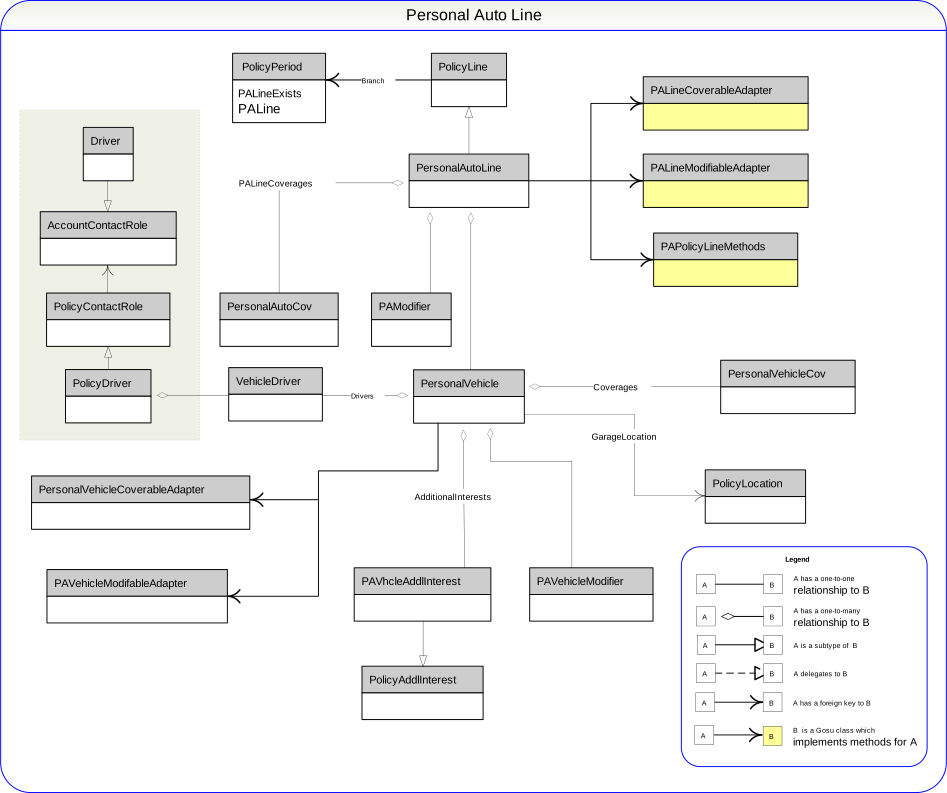
The PolicyLine entity contains several subtypes, one of
which is PersonalAutoLine. (Each line of business is a subtype of
PolicyLine.) The object model diagram displays relationships which
may not be readily apparent. For example, the objects in the shaded portion of the
diagram represent a role on the policy, each entity holds portions of the information
needed in constructing the policy.
See also
PersonalVehicle entity
The main entity for personal auto is PersonalVehicle,
which is a coverable. The PersonalVehicle entity tracks items
such as VIN numbers, the make, model, color, and type of vehicle. The personal
vehicle can be a green 2007 Toyota Camry with a particular VIN number. Notice that
PersonalVehicle links to the VehicleDriver
entity in a one-to-many relationship. This indicates that multiple drivers can be
associated with (drive) the same vehicle.
A number of arrays that store additional information link to this entity. The following table lists some of these arrays. For complete information, see the PolicyCenter Data Dictionary.
|
Array |
Stores information on |
|---|---|
|
|
Third parties with an additional interest in the vehicle (for example, a bank) |
|
|
All coverages that apply directly to this vehicle |
|
|
All drivers associated with this vehicle |
|
|
Rating information that can affect the premium quote for this vehicle |
Coverable interface. In brief, a coverable is an
exposure to risk that can be protected by the policy. A coverable may be a tangible
property item, a location, jurisdiction, or the policy itself. Coverages attach only
to coverables. For information on what constitutes a coverable, see Coverages, exclusions, conditions, and coverables overview.VehicleDriver entity
The VehicleDriver entity is functionally a join
table between PolicyDriver and PersonalVehicle. It
contains one record for each driver on a vehicle. The
VehicleDriver entity links to both the
PersonalVehicle entity and the
PolicyDriver entity in a one-to-many relationship. If
multiple drivers drive one car, then multiple drivers are associated with that
vehicle.
The VehicleDriver entity includes such information as the following:
|
Field |
Description |
|---|---|
|
|
Indicates whether this driver is primary for the given vehicle or not (used by rating) |
|
|
The percentage this driver drives the vehicle |
PolicyDriver entity
The PolicyDriver entity (subtype of
PolicyContact) contains the array of vehicle drivers. The
relationship between the PolicyDriver entity, the
VehicleDriver entity, and the
PersonalVehicle entity can then be stated, for example as the
following:
John Smith is the primary driver of a green 2007 Toyota Camry with VIN number 12345.
The PolicyDriver entity also contains the current
ApplicableGoodDriverDiscount. This is the driver discount that
applies to this policy. This is not the same as whether the driver currently
qualifies for a good driver discount. The GoodDriverDiscount is on
the Driver entity.
Driver entity
The Driver entity contains information such as
driver training, number of accidents and violations, and indicates whether this is
the primary driver. It also indicates whether the driver currently qualifies for a
good driver discount. Most of the information related to the driver comes from the
Driver (account contact) entity. The Driver
entity, in conjunction with the other entities in the shaded portion of the personal
auto line diagram, stores the driver information on the policy.
Coverages
A coverage can be defined as a protection from a specific risk. A
coverage entity must implement the Coverage interface. Coverages
always attach to a coverable. There are two types of coverages: property and
liability. For example, on an auto policy, a collision property coverage protects
the insured’s vehicle and a liability coverage protects the driver for damage done
to someone else’s vehicle.
In the base configuration, the personal auto policy line has two types of coverages:
|
Coverage type |
Attaches to |
Description |
|---|---|---|
|
|
|
Coverage choices that apply to all vehicles in that policy, such as liability coverage. |
|
|
|
Coverage choices that apply to a specific vehicle, such as a comprehensive deductible or collision information. |
Modifiers
A modifier is a value used by the rating engine to adjust the policy premium or some portion of the premium. Modifiers capture information relevant to the pricing of a policy that are not necessarily tied to a specific coverable or coverage. In personal auto, there are the following types of modifiers:
|
Modifier type |
Applies to |
Description |
|---|---|---|
|
|
The entire policy |
A modifier of the policy line. Multi-policy discount or no-loss discount. |
|
|
A specific vehicle |
A modifier of the vehicle. Premium discounts for such things as ABS (anti-locking brakes), passive restraint, or anti-theft devices. |